
As AI Gets Better, Code Gets Cheaper: The Business Domain Model Is What Really Matters

AI can accelerate code generation; the domain model ensures that code delivers business value.
Companies do not pay for lines of code. They pay for higher revenue, better customer experiences, lower operating costs, and more manageable risk. AI reduces the cost of generating code; DDD protects the business value that code is supposed to deliver.
AI can generate APIs, database tables, tests, and deployment scripts in minutes. That raises a question: as code becomes easier to generate, is domain-driven design (DDD) still worth learning?
The better AI gets at writing code, the more important DDD becomes.
AI is good at answering “how should this be written?” The hardest questions in software are “why should we build this?” and “what is actually valuable?” The faster generation becomes, the faster vague requirements, incorrect boundaries, and implicit rules spread. Without a clear domain model, AI resembles a high-speed outsourcing team that rarely challenges a flawed requirement.
Coding Is Losing Value; Business Outcomes Are Gaining It

Code output is no longer the bottleneck; business outcomes increasingly determine delivery value.
Asking AI to generate a standard CRUD module is often faster than writing one by hand. But an entire business domain lies between “it runs” and “it creates value.”
Should canceling an order release inventory? Should a coupon be returned? Can an order that has already shipped be canceled? How should a partial refund allocate an order-level discount? Is the same customer represented by the same model in sales, risk, and finance?
The answers live in business experience, past incidents, and tacit consensus. When a rule is wrong, the loss is not build time; it may be inventory, money, fulfillment cost, and customer trust.
In the METR 2025 randomized controlled trial, 16 developers familiar with their respective open-source projects completed 246 real tasks; using the AI tools available at the time increased completion time by 19%. The result applies only to early-2025 tools, that sample, and mature repositories. It cannot be generalized into “AI is useless,” but it does show that the cost of complex systems also includes understanding context, judging correctness, and validating results.
DORA 2025 describes AI as an “amplifier”: teams with clear models, stable boundaries, and reliable tests can validate business hypotheses faster, while teams with muddled concepts and invisible rules can produce rework, incidents, and technical debt faster too.
What gains value in the AI era, then, is not prompting technique but domain knowledge that can translate strategic intent into revenue, experience, efficiency, and risk control. That is exactly where DDD excels.
CRUD Gives AI Data; DDD Gives AI Semantics

CRUD asks whether data can be stored; DDD asks whether business value can be realized.
Data-driven design often starts with an orders table, a status field, and an update endpoint. That is enough for AI to generate code, but not enough to determine which changes are valid.
Given a requirement to “add an endpoint for changing order status,” AI can easily generate updateOrderStatus(id, status) while bypassing the essential questions: who may change it? Which state transitions are allowed? What must happen afterward? What must remain unchanged when it fails?
The danger in this code is not that it fails to run. It is that it runs the wrong business model perfectly smoothly: losses that should have been prevented are not, and customer commitments that should have been honored are not.
DDD begins with “what happened in the business?” It establishes a ubiquitous language, bounded contexts, aggregates, and invariants, then expresses intent and facts through commands and domain events. Eric Evans’s DDD Reference provides a systematic summary of these patterns.
From the perspective of collaborating with AI, DDD is a natural form of “context engineering.” From a business perspective, it protects the return on software investment.
| DDD capability | Value for AI collaboration | Business value |
|---|---|---|
| Ubiquitous language | Reduces semantic guesswork | Reduces misunderstood requirements and rework |
| Bounded contexts | Narrows the relevant context | Improves team autonomy and response speed |
| Aggregates and invariants | Establish non-bypassable guardrails | Protects money, inventory, fulfillment, and compliance |
| Commands and domain events | Make intent and facts explicit | Supports auditing, operations, and decisions |
| Domain tests | Create mechanical feedback | Shortens delivery cycles and reduces release risk |
Ubiquitous Language: Give AI a Business Dictionary

Communication costs and rework fall when each business meaning has one expression.
AI can only infer company-specific meanings from context. If product calls someone a “member,” the database calls them customer, an API uses user, and the code introduces account, AI can easily collapse four distinct concepts into one.
A ubiquitous language gives domain experts, product managers, developers, testers, and the codebase the same vocabulary. When “pay order” maps to PayOrder and OrderPaid in code, AI no longer has to guess whether setStatus(PAID) is equivalent to payment, and the team can judge more quickly whether a feature genuinely improves payment success, reconciliation efficiency, or customer experience.
A ubiquitous language reduces more than communication overhead; it reduces the expensive rework that carries a misunderstanding all the way into the wrong product.
Bounded Contexts: Turn Business Boundaries into Context Boundaries for AI

The clearer the boundaries, the more independently teams can respond to business change.
A “customer” represents purchasing preferences in a sales context, risk in a risk-management context, and receivables in a finance context. A company-wide, all-purpose Customer object creates coupling and prevents AI from knowing which rules a change might affect.
Bounded contexts make the scope of terminology, model ownership, and collaboration contracts explicit. AI can identify the business domain first, then read that domain’s models, rules, and tests instead of loading the entire repository into context at once. For the business, this means a marketing change does not have to drag finance and risk into the same release, and responsibility no longer disappears inside cross-system coupling.
OpenAI’s agent-first engineering practice emphasizes making repository knowledge discoverable and constraining agents with predictable structures and mechanical boundaries. Bounded contexts are the business backbone of such an agent-readable architecture.
Aggregates and Invariants: Tell AI What Must Never Go Wrong

Invariants protect more than code cleanliness; they protect the bottom line for money, inventory, fulfillment, and compliance.
The real danger is not a syntax error but something that is “technically correct and wrong for the business.” Aggregates define consistency boundaries, while invariants define rules that must always hold: an unpaid order cannot ship; a balance cannot fall below the frozen amount; a coupon cannot be redeemed twice. The domain model should guard these rules in one place.
Once invariants live inside the aggregate, AI may refactor interfaces or generate adapters, but it cannot arbitrarily change state by bypassing the domain entry point. The architecture no longer relies on a “please be careful” prompt. Code boundaries and tests enforce it together. Every rejected illegal state transition may prevent an oversell, an incorrect payment, a compliance breach, or a customer complaint.
The best AI guardrail is not a longer prompt but a domain invariant that cannot easily be bypassed.
Commands and Events: Rewrite Vague Requirements as Intent and Facts

Commands express business intent; events preserve auditable, analyzable business facts.
updateStatus describes a database operation; ShipOrder describes business intent. status = SHIPPED describes a field value; OrderShipped describes a fact that has occurred.
Commands tell AI “what the user is trying to do,” while events tell it “what the system accepted as having happened.” When a problem occurs, people and AI can follow the causal chain instead of reverse-engineering business meaning from field differences. These business facts can also support audits, funnel analysis, operational automation, and product decisions, turning runtime records into business feedback.
Commands and domain events do not mean that a system must adopt CQRS or Event Sourcing. The decision to introduce read models, event stores, and asynchronous architecture should follow the system’s actual complexity.
Domain Tests: Build an Executable Feedback Loop for AI

Executable business rules improve both delivery speed and confidence in a release.
A requirements document tells AI roughly what to do. A Given–When–Then domain test defines what event should result from a command given a history of events, which operations must be rejected, and which state must remain unchanged. It is both a regression test and a living specification.
After AI changes code, it can receive immediate feedback. When a business rule changes, updating the scenario first also updates AI’s target. This shortens the hypothesis–implementation–validation–release cycle and stops regression risk before it affects revenue or customers. A domain model with executable examples is a contract that can support ongoing work by AI.
A Real Example: Let the Order Model Tell AI the Rules Directly

A clear state progression protects not only code correctness but also order revenue and customer commitments.
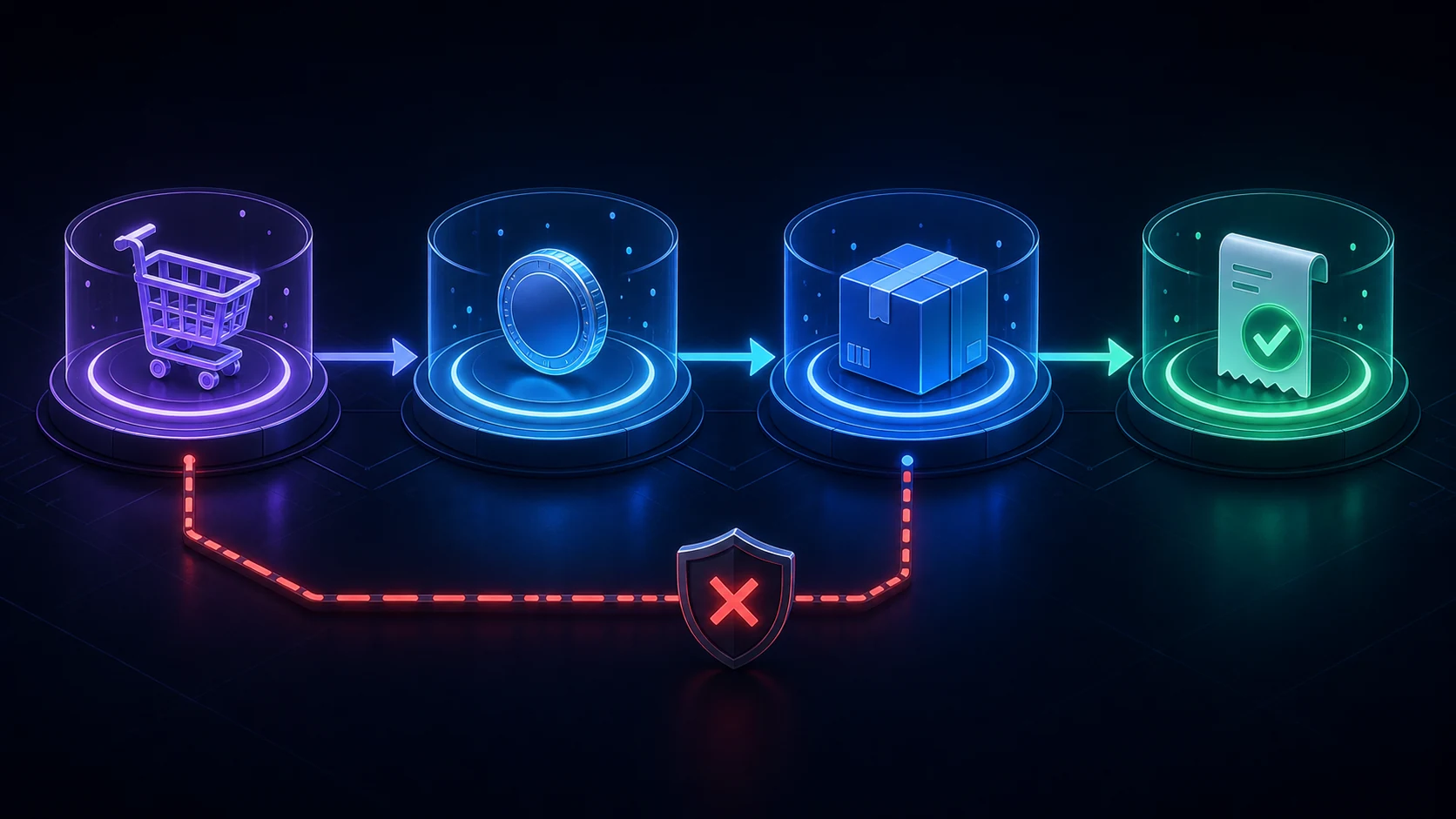
Wow’s order example expresses business actions as a clear sequence:
CreateOrder → OrderCreated
PayOrder → OrderPaid
ShipOrder → OrderShipped
ReceiptOrder → OrderReceivedIn the Order aggregate, changing an address, shipping, and acknowledging receipt are separate command-handling behaviors rather than arbitrary assignments to status. The aggregate verifies that the order has been paid before shipping and that it has shipped before acknowledging receipt. CreateOrder and OrderCreated likewise express the intent to place an order and its result separately.
The corresponding OrderSpec starts by creating an order, then verifies payment, shipping, receipt, repeated payment, and other branches. It also explicitly verifies that “ship without payment” must fail while leaving state unchanged. This rule directly prevents fulfillment without revenue, subsequent recovery and reconciliation costs, and the damage an incorrect shipment does to the customer experience. The core concepts in the Wow documentation explain the relationship among aggregates, commands, events, and state.
Now suppose AI receives a requirement: “Allow the delivery address to be changed after payment but before shipment.” In an ordinary CRUD system, AI might find the address field and update the database directly. In this model, it will discover that address changes currently allow only the CREATED state, shipping requires PAID, and existing tests already define the main state progression. It must therefore work through the business rules: confirm the product intent, adjust the aggregate constraint, add both allowed and rejected scenarios, and then run the domain tests.
DDD does not make the business decision for AI. It makes the fulfillment experience, warehouse and distribution costs, and order risk behind “allow address changes” discussable, implementable, and verifiable.
DDD Is Not a Silver Bullet for the AI Era

Investment in DDD should serve core differentiation and high-risk business capabilities, not architectural theater.
Being a better fit for the AI era does not mean every project should be packed with aggregates, factories, repositories, sagas, and event buses. For an internal directory, a one-off campaign administration tool, or a management page with very few rules, clear CRUD may offer a better return on investment.
AI will amplify a flawed domain model too. If the ubiquitous language is itself ambiguous, the boundaries are wrong, or tests codify incorrect rules, AI will only copy the problem more efficiently. Domain experts remain irreplaceable, and people must remain accountable for critical decisions.
The right sequence is to identify the core domains that determine differentiation, revenue, or material risk, then invest in modeling the high-value, high-change parts. Keep supporting and generic domains simple. The purpose of DDD is not to make the architecture look sophisticated. It is to direct a limited engineering budget toward the business capabilities most worth protecting.
Six Things a Team Can Start Doing Today

Start with one business outcome and connect value, rules, code, and validation into a closed loop.
- Write the business outcome first. State whether the goal is to improve conversion, fulfillment speed, inventory accuracy, loss rates, or customer satisfaction.
- Build a ubiquitous language. Find ambiguous terms across requirements, code, APIs, and tests so that business, product, engineering, and AI use each term with the same meaning.
- Define bounded contexts. Start with one core scenario and make model ownership, collaboration contracts, and non-negotiable dependency boundaries explicit.
- Express value and risk as invariants. For example, “an unpaid order cannot ship.” Give critical rules for money, inventory, and compliance one authoritative guardian.
- Express scenarios through business actions and tests. Replace universal update endpoints with
PayOrderandCancelOrder, and cover both successful and rejected paths with Given–When–Then. - Bring knowledge and metrics into the repository. Version the glossary, contexts, decisions, tests, and business metrics together so people and AI share the same facts and feedback.
These six actions share one goal: turn tacit knowledge that “only veteran employees know” into an organizational asset that people and AI can read, execute, verify, and use to produce business outcomes continuously.
Conclusion: Code Will Keep Getting Cheaper; Business Value Will Not

AI increases implementation throughput; the domain model determines whether those implementations produce business outcomes.
AI will continue to improve. Boilerplate will become cheaper, and refactoring will become faster. But companies will still have to answer: what is an order? What is a commitment? What may change? What must never be broken? How should different parts of the business collaborate?
In the past, DDD helped large teams manage complexity. In the AI era, it gains another mission: translate revenue logic, customer commitments, operational rules, and risk limits into an engineering language in which machines can participate but which they cannot arbitrarily rewrite.
When code is no longer scarce, the domain model becomes a reusable, verifiable, and continuously evolvable digital asset for the enterprise. Only teams that can define the right problems, build clear models, and protect business boundaries can turn AI’s technical leverage into business leverage.
The AI era does not make DDD obsolete.
On the contrary: the better AI gets at writing code, the more important it is for us to know which outcomes are worth pursuing and which code is worth writing.
References

Evidence supports the argument; clear boundaries prevent overstatement.